
What changed
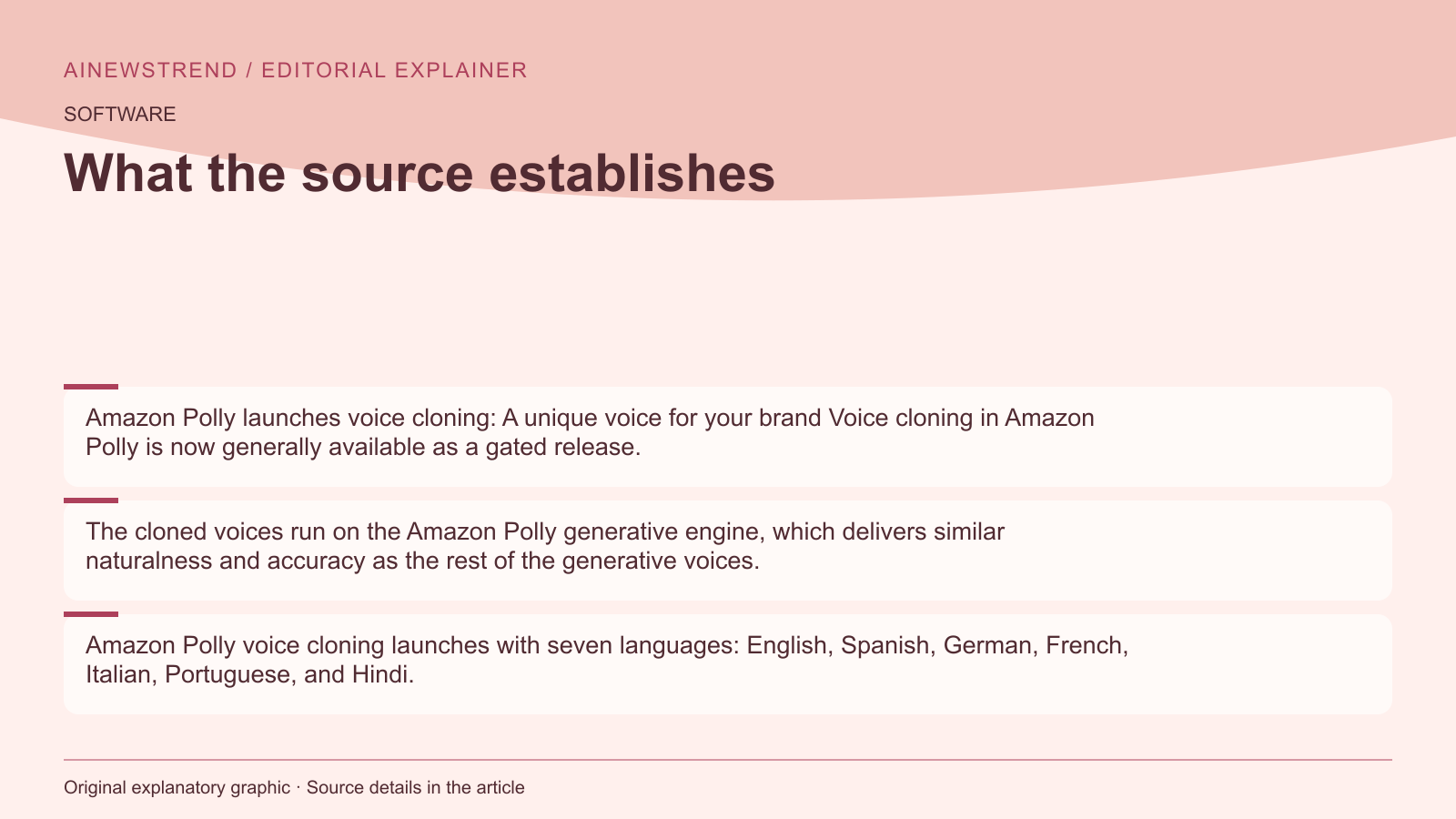
Amazon Polly has introduced voice cloning, enabling users to generate a unique voice for their brand using a few minutes of audio recordings from a speaker who has consented to have their voice cloned. The cloned voices are built using the Amazon Polly generative engine, which provides similar naturalness and accuracy as other generative voices. Voice cloning is now generally available as a gated release.
What this means in practice
To use voice cloning, users provide Amazon Polly with audio recordings of a speaker, along with the language the recordings are in. The process involves four steps: recording, creating, waiting, and using the cloned voice. The cloned voices are encrypted and access-controlled, ensuring only the creator can access them. Voice cloning supports seven languages: English, Spanish, German, French, Italian, Portuguese, and Hindi. Each cloned voice speaks only the language it was recorded in. Users can integrate the cloned voice into their applications, and the feature is available in all AWS Regions supported by the Amazon Polly generative engine, including the AWS GovCloud (US) Region.
Limitations and availability
Voice cloning is available as a gated release, with access already enabled for select Amazon Polly customers. Others can request access through their AWS account team. The feature is free to build, but usage is billed on a pay-as-you-go basis. Cloned voices are scoped to the AWS account that created them and can be encrypted using an AWS KMS key. Users must confirm the speaker’s consent for each voice they create and control access through IAM. Amazon Polly does not retain copies of the original voice recordings once the voice is created and only stores the data needed for speech synthesis, encrypted.