
What changed
AMD has demonstrated a complete local pipeline for generating playable 3D worlds from text prompts using Radeon graphics and ROCm software. The process involves creating a scene from a single text prompt, generating camera-controlled video, converting that video into 3D geometry, and integrating AI-driven NPCs and reinforcement learning agents to create an interactive game environment.
What this means in practice
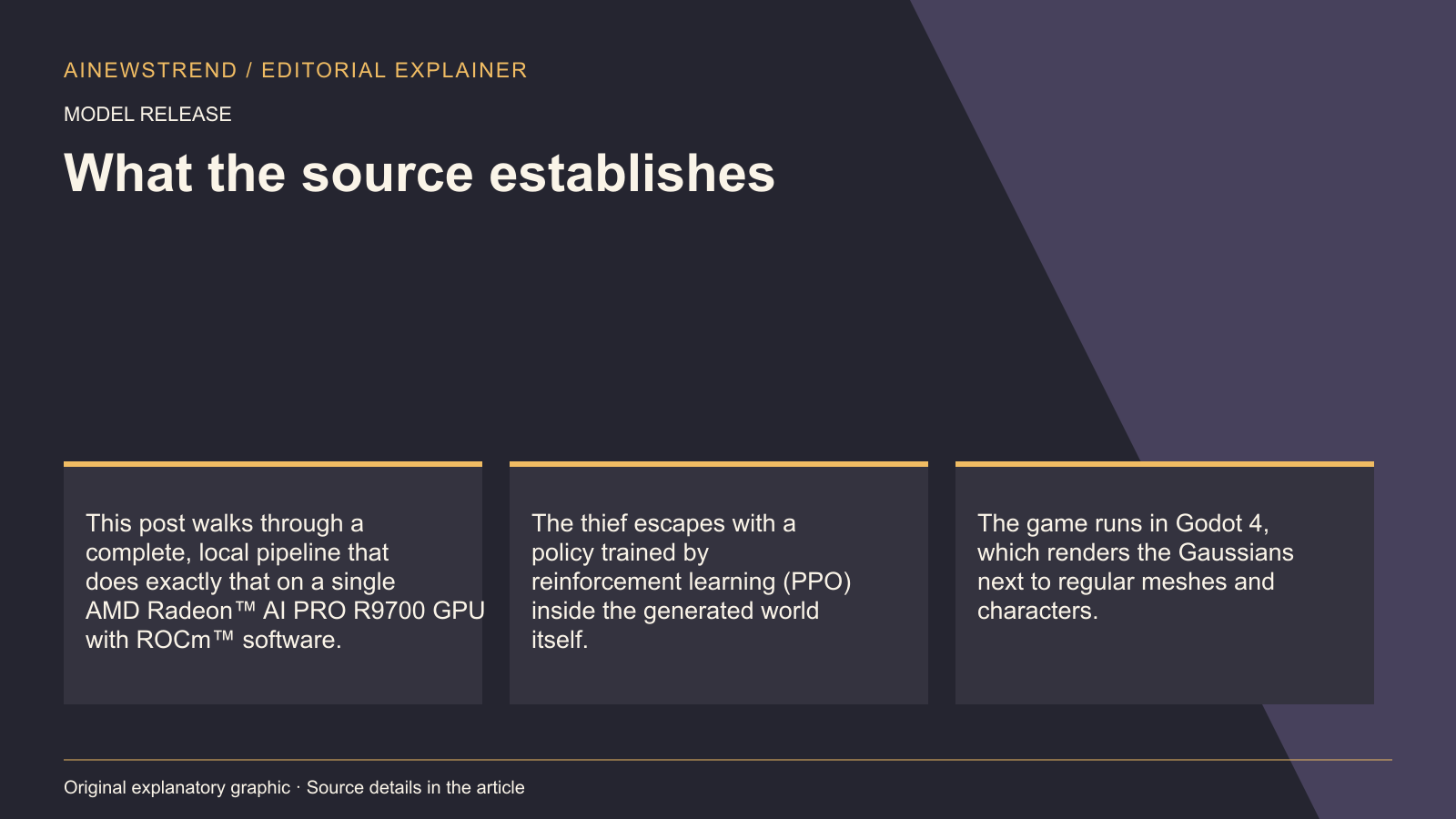
The demonstration uses an AMD Radeon AI PRO R9700 GPU with ROCm software to build a small playable scene where a thief steals a pie, and the player and villagers attempt to catch him. The world is generated from a text prompt using the Wan2.2 video world model, then converted into 3D Gaussians using Depth Anything 3 and gsplat. NPCs are driven by the Qwen3-8B LLM, with speech input and output handled by Qwen3-TTS and Whisper. The thief's behavior is controlled by a reinforcement learning policy trained within the generated world. The game runs in Godot 4, which renders the 3D elements alongside regular meshes and characters.
Limitations and availability
The demonstration requires an AMD Radeon graphics card with sufficient memory for a 5B-parameter video model, specifically the Radeon AI PRO R9700 (RDNA™ 4 architecture, gfx1201, 32 GB). It also needs Linux with ROCm 10.0, Docker, and access to /dev/kfd and /dev/dri. The pipeline runs in three containers that share the GPU: one for the NPC LLM, one for voice processing, and one for world generation and training. During gameplay, only Godot, the LLM server, and the voice server run, with the trained RL policy evaluated directly by Godot. The supplied announcement does not specify the exact release date or availability of the full pipeline outside the demonstration.