
What changed
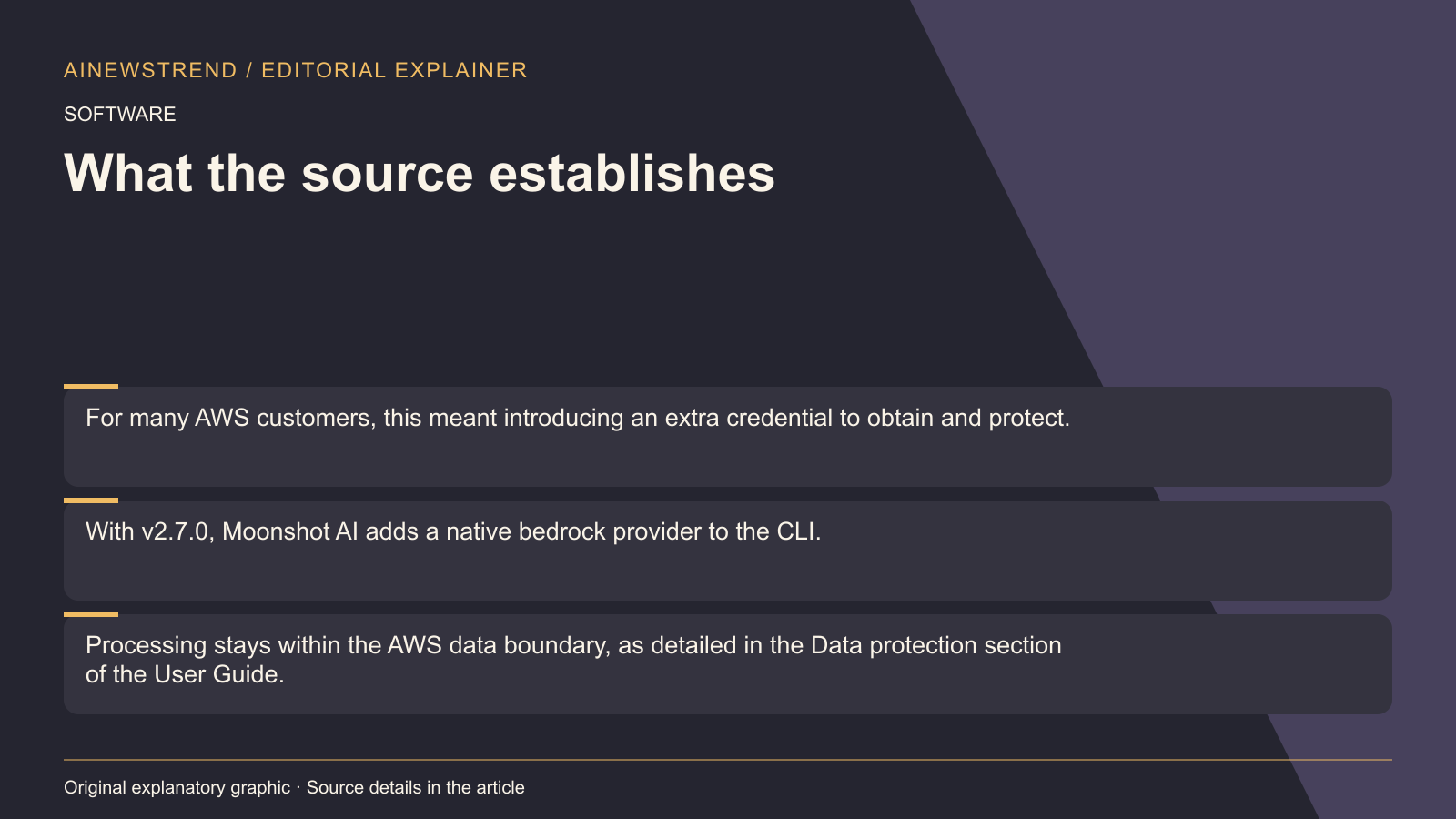
Moonshot AI has released version 2.7.0 of the Kimi Code CLI, introducing a native provider for Amazon Bedrock. This update allows users to connect to Bedrock models using their existing AWS credentials instead of managing a separate API key.
What this means in practice
Previously, users had to configure a generic provider with an Amazon Bedrock API key, which added an extra credential to manage. With the new native provider, the CLI can use the standard AWS credential chain, including named profiles and single sign-on (SSO). This change streamlines the authentication process and reduces the need for manually managing API keys.
Limitations and availability
The native provider resolves temporary credentials through the AWS CLI credential chain and generates short-lived bearer tokens. These tokens are valid for up to 12 hours or the length of the AWS session, whichever is shorter. The provider infers the API format and regional endpoint from the model ID, but users can override these settings if needed. The update is available for Kimi Code CLI v2.7.0 and later, and requires an AWS account with access to the target model and inference profile in a supported AWS Region. The example model used in the announcement is Kimi K3.1 Pro Highspeed, which supports streaming, configurable reasoning, image input, and client-side tool calling.
The supplied announcement does not specify the exact number of models supported or the full list of available features across all models. Users are advised to review the model cards for specific API and feature support.
Additionally, the IAM policy provided in the announcement is specific to the Kimi K3.1 Pro Highspeed model and global inference profile, and users must replace placeholders with their actual AWS Region and account ID.