
What changed
OpenAI introduced MedChemBench, a benchmark that evaluates AI models on reasoning tasks related to medicinal chemistry. The benchmark tests whether models can connect molecular structures with experimental evidence to explain results, compare compounds, and predict their properties. It draws on 117 papers and patents and includes 761 distinct molecular structures.
What this means in practice
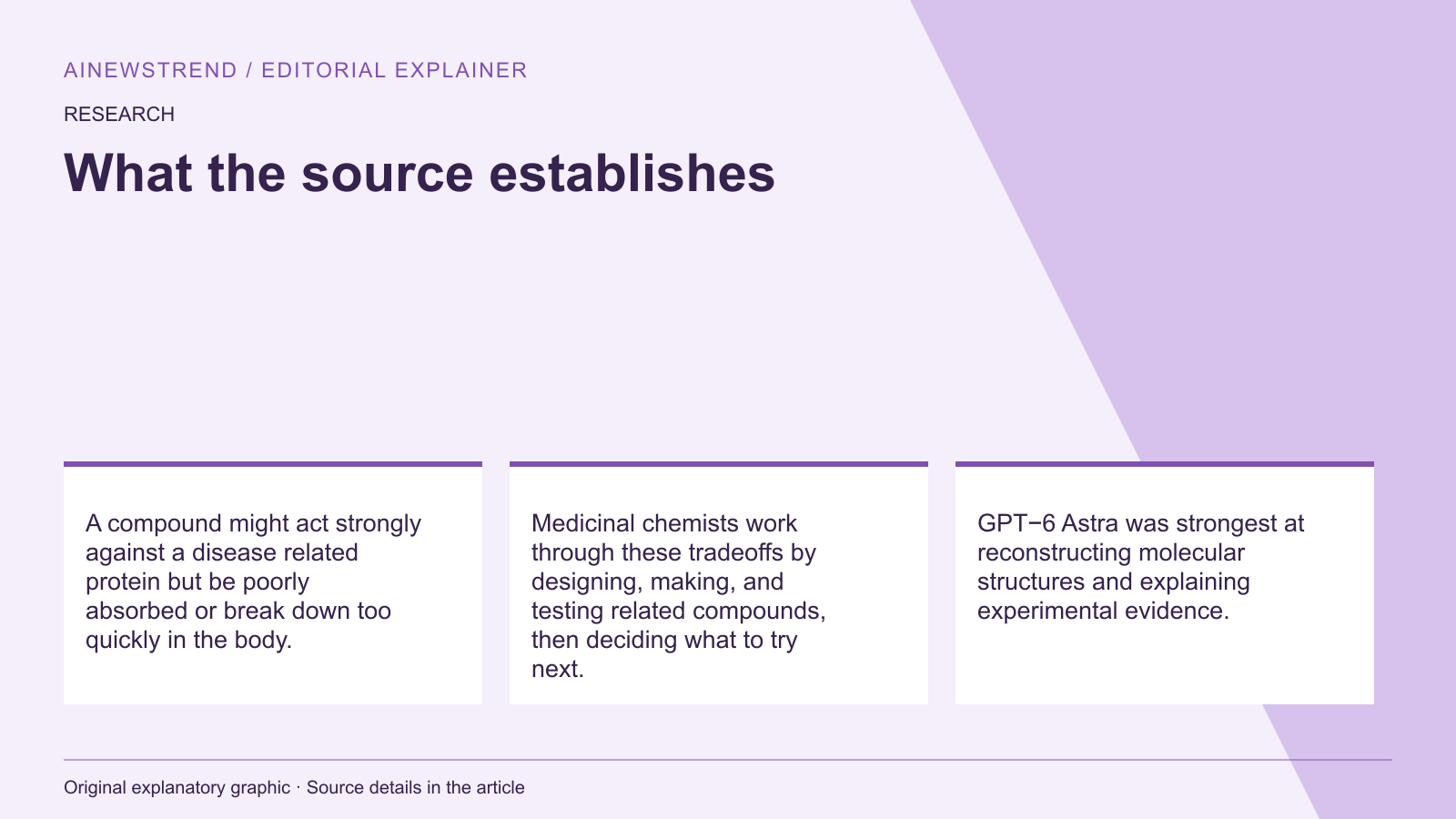
MedChemBench measures four components: molecular structures, scientific reasoning, ranking and selection, and property predictions. Models receive context available at a chosen point in a research program, including the biological target, researchers’ goals, compounds studied so far, and selected experimental findings. At the xhigh reasoning setting, GPT-6.2 Astra earned 84.5% of the available credit, compared with 83.3% for GPT-6 Astra, 82.0% for GPT-6.1 Sol, and 58.2% for GPT-5.6 Sol. GPT-6 Astra was strongest at reconstructing molecular structures and explaining experimental evidence.
Limitations and availability
The benchmark evaluates models across different reasoning-effort settings, with performance plotted against output tokens. Astra earned 83.3% of the available credit at the shared xhigh setting, compared with 82.0% for GPT-6.1 Sol, 75.1% for GPT-6.1 Terra, and 58.2% for GPT-5.6 Sol. At max effort, GPT-6 Astra reached 83.8%. The benchmark checks whether models reconstruct molecular structures correctly and how closely their predictions match experimental measurements. Predictions receive partial credit based on their closeness to measured values. The supplied announcement does not specify the exact availability or access route for MedChemBench.