
What changed
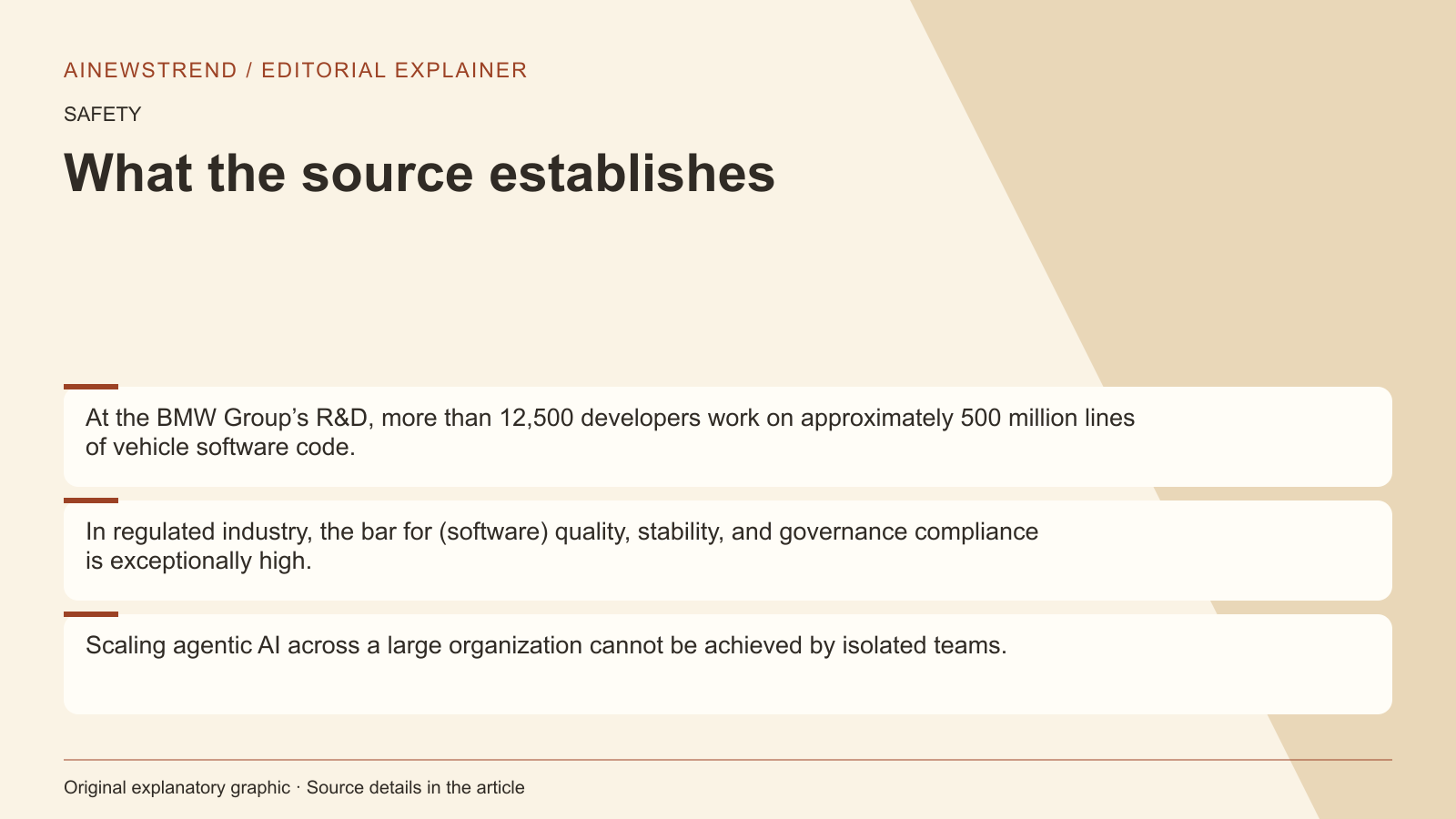
The BMW Group has announced a new governance framework designed to manage the development and operation of hundreds of AI agents across its 12,500 developers.
This framework is intended to address the challenges of scaling agentic AI systems while maintaining compliance, safety, and efficiency. The initiative is part of the BMW Connected Vehicle backend, which supports over 24 million vehicles in the field.
What this means in practice
The framework emphasizes proactive governance, continuous instrumentation, and a structured approach to assigning trust levels to different agent actions.
It includes a Model Context Protocol (MCP) gateway, a central agent registry, and orchestration boundaries to enforce governance rules across the full lifecycle of agent development.
The governance rules cover authentication, authorization, rate limiting, and content filtering, ensuring that these are enforced at the integration layer rather than within individual agent codebases.
The framework also introduces three levels of autonomy for agent actions: Level 0 (Human-in-the-loop), Level 1 (Human-on-the-loop), and Level 2 (Autonomous within guardrails).
These levels are based on the risk associated with specific actions, such as drafting documentation, updating customer records, or production database writes. Governance checks are enforced through CI/CD pipelines, ensuring that all deployments meet compliance and quality standards before reaching production.
Limitations and availability
The supplied announcement does not specify the exact implementation timeline or the availability of the framework across all BMW Group teams. The framework is part of the BMW Connected Vehicle backend and is intended for use by developers working on vehicle software.
The solution is organized around five interlocking practices, codified as infrastructure as code (IaC), to ensure repeatable, auditable, and enforceable adoption across teams without blocking DevOps velocity.