
What changed
Chinese tech firms are encountering significant challenges as US export controls disrupt both physical chip shipments and overseas cloud access.
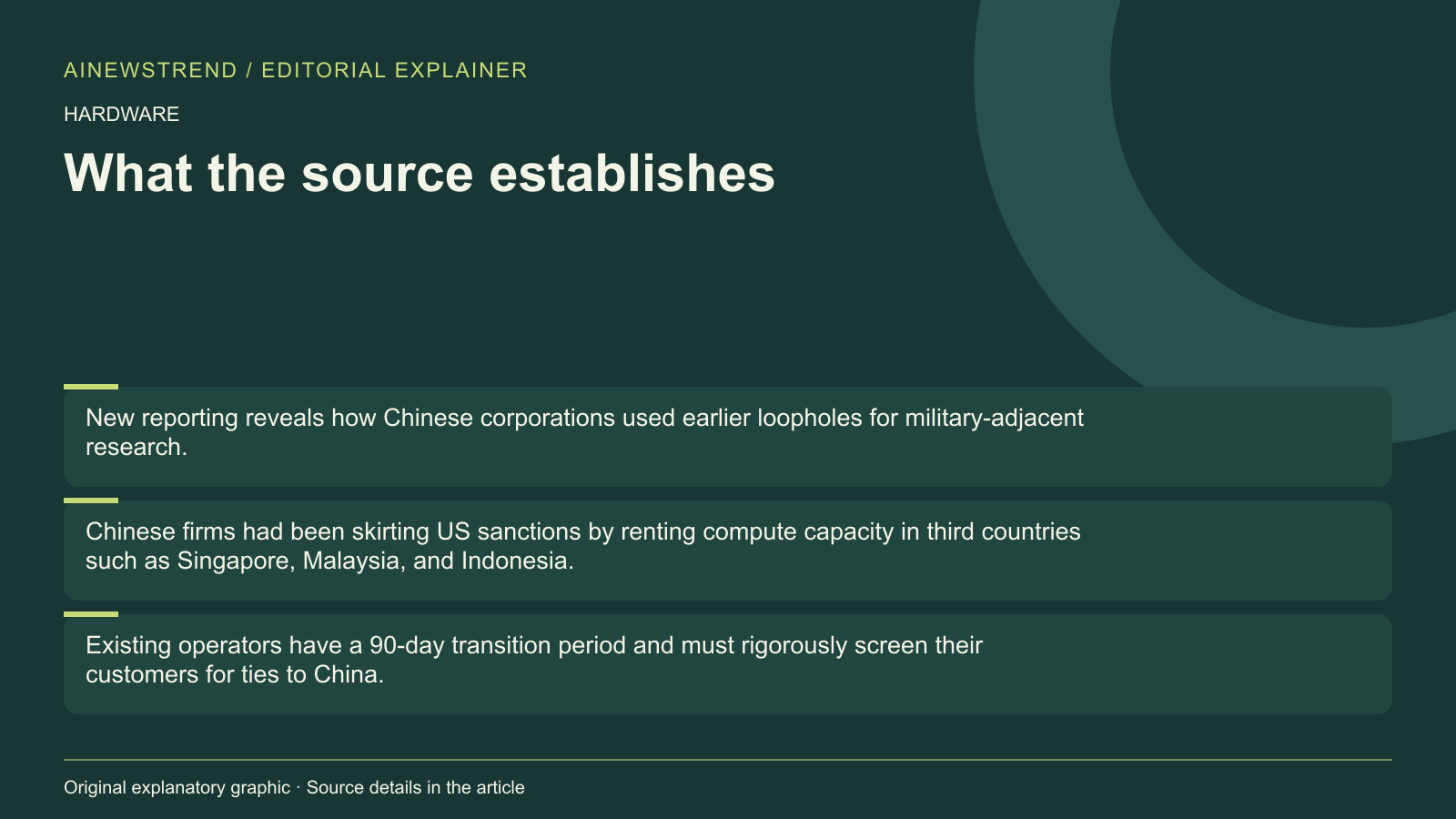
The US Commerce Department has tightened regulations, closing loopholes that allowed Chinese companies to bypass sanctions by renting compute capacity in third countries like Singapore, Malaysia, and Indonesia.
These data centers now require licenses from the Bureau of Industry and Security (BIS), with a low threshold for triggering licensing requirements—equivalent to roughly 300 modern AI chips, far below the several thousand processors typically needed by Chinese labs.
What this means in practice
The restrictions have already led to major business impacts. For instance, Beijing-based startup Moonshot AI canceled a $150 million contract with a Southeast Asian cloud provider in Indonesia and paused talks on additional deals.
The company had planned to rent a large cluster of Nvidia Blackwell Ultra B300 chips there to train its next language model, Kimi K4.
The move comes after the US closed the cloud loophole for AI chips, following a scandal involving former Nvidia CEO Jensen Huang.
Additionally, five lenders are considering dropping out of a $480 million loan for Singapore-based cloud provider Aolani, which was supposed to supply Nvidia chips in Malaysia for TikTok parent ByteDance.
Limitations and availability
Beyond cloud restrictions, the new US rules are also affecting physical supply chains. Contract manufacturers TSMC and Samsung have halted certain processor shipments to Chinese customers while applying for Commerce Department licenses.
This move hits Chinese tech firms at a time when they are already struggling with high memory chip prices and capacity bottlenecks at domestic foundries like SMIC. Huawei recently told its customers to source their own memory for its new AI chip.
The new BIS rules also block a workaround through independent packaging and testing firms, impacting Samsung's customers such as ByteDance and Baidu's AI data center unit Kunlun.